%20(2200%20x%20300%20px).png)
How SaaS Brands Can Show Up in AI Search
.svg)
%20(1)%20(1)%20(1).png)
How SaaS Brands Can Show Up in AI Search
ChatGPT and Google AI Mode are showing SaaS-related answers to your prospects. Which pages from websites do they use? Which third-party sources reinforce those answers? And once a user decides to continue, where does the referral actually go?
To find out, let’s review this analysis of 15 leading SaaS brand ecosystems, pairing Semrush citation data for ChatGPT and Google AI Mode with Similarweb’s data for AI referrals.
The benchmark ties together three parts of the AI search journey:
- Owned pages earning citations
- External sources backing those answers
- The URLs actually receiving AI traffic afterwards
These layers often serve different purposes. An AI system might cite one page to explain or recommend a product, then send the user, or agent, elsewhere.
Where they end up depends on the SaaS category and the task left to finish like:
- Opening an app
- Evaluating a solution
- Reading support content
- Accessing a workspace.
Across these brands, five patterns were consistent enough to optimize around.
Let’s dive in.
1. Most AI citation weight comes from outside your own website
Third-party sources account for 84 to 93 percent of citation weight across every subvertical and both platforms.
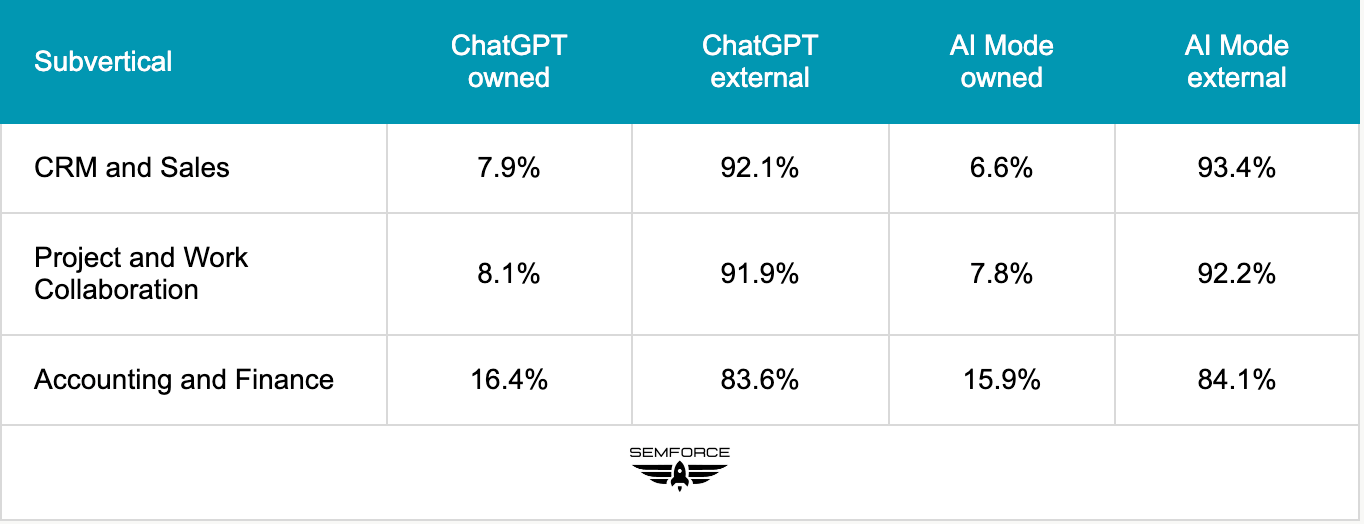
Creating authoritative content for your own site is necessary but rarely sufficient. With 84 to 93 percent of citation weight sitting on third-party sites, the external ecosystem, including publishers, needs to be a first-class AI visibility channel with its own strategy.
Prioritize the pages LLMs reuse, not just the sites they cite.
ChatGPT keeps pulling from the same small set of evaluative pages, while community visibility builds up through sheer volume across thousands of threads. Landing one accurate, well-placed mention in a page that gets reused often beats scattered, low-impact coverage. How you're described there counts for just as much as being mentioned at all.
Become a source for your category, not just your brand.
At roughly 25 percent of head source mentions, peer software vendors are the biggest classified source type ChatGPT draws on across all three subverticals. Original research, benchmarks, calculators, and integration documentation can get cited in answers covering the whole category, including ones about competitors. It's the same content that wins unprompted press coverage: journalists reach for original data because it makes their reporting credible, and AI systems pull it in for the same reason.
Build the video layer for AI Mode.
ChatGPT's evidence mix barely touches video, at roughly 1 percent, but it's the biggest external ecosystem inside AI Mode, at roughly 23 percent. Tutorials, demos, and walkthroughs don't function as brand marketing in this context. They function as citation assets.
2. ChatGPT and AI Mode rely on different types of external evidence
These two platforms draw answers from different evidence ecosystems. ChatGPT draws mainly on structured written sources. AI Mode leans much more heavily on video, creator, and social content.
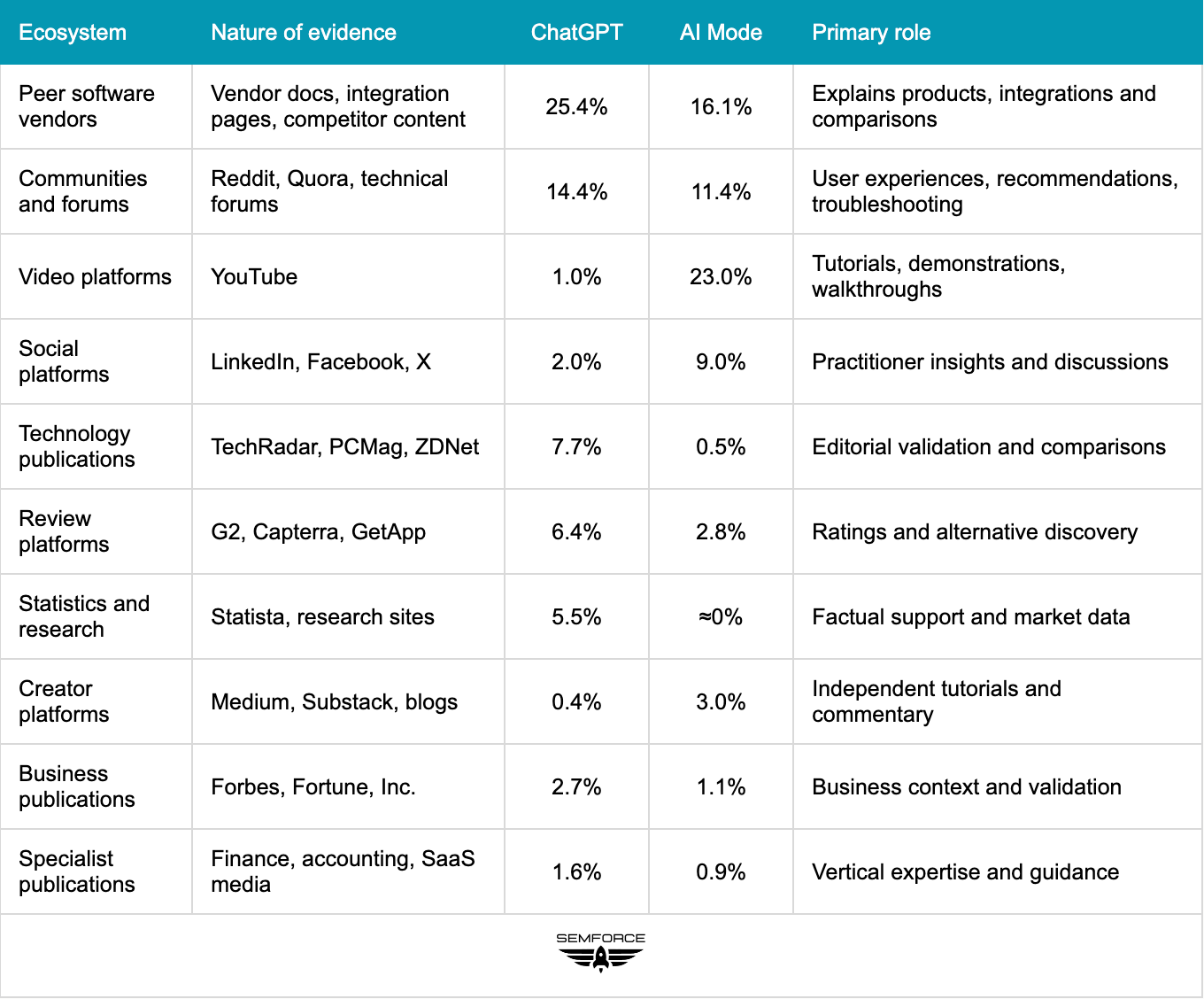
Notice the chunk of publications getting cited, like business and technology publications. Don't write off an LLM because one platform ignores it. Technology publications are near invisible in AI Mode, at 0.5 percent, yet a top written ecosystem in ChatGPT. Treat media outlet selection and message accuracy in earned coverage as AI citation infrastructure, not just brand building.
We have placed clients in some of these tech publications (like TechCrunch, Fast Company, and CIO), and see the overall lift in LLMs and brand awareness. If you want the same for your business, see our public relations service or contact us for a short intro call.
3. ChatGPT and AI Mode also cite different parts of your own website
When ChatGPT cites your site, it usually points to your main pages, like your homepage or top-level brand pages. When Google AI Mode cites your site, it usually points to pages buried a bit deeper, like a specific guide, doc, template, or comparison page rather than your homepage.
this doesn't mean burying content deeper on your site makes it more likely to get cited. It just means that when AI Mode does cite something, it happens to be the deeper, more specific pages, because those are the pages that actually answer the specific question being asked. So don’t restructure your site to bury pages on purpose.
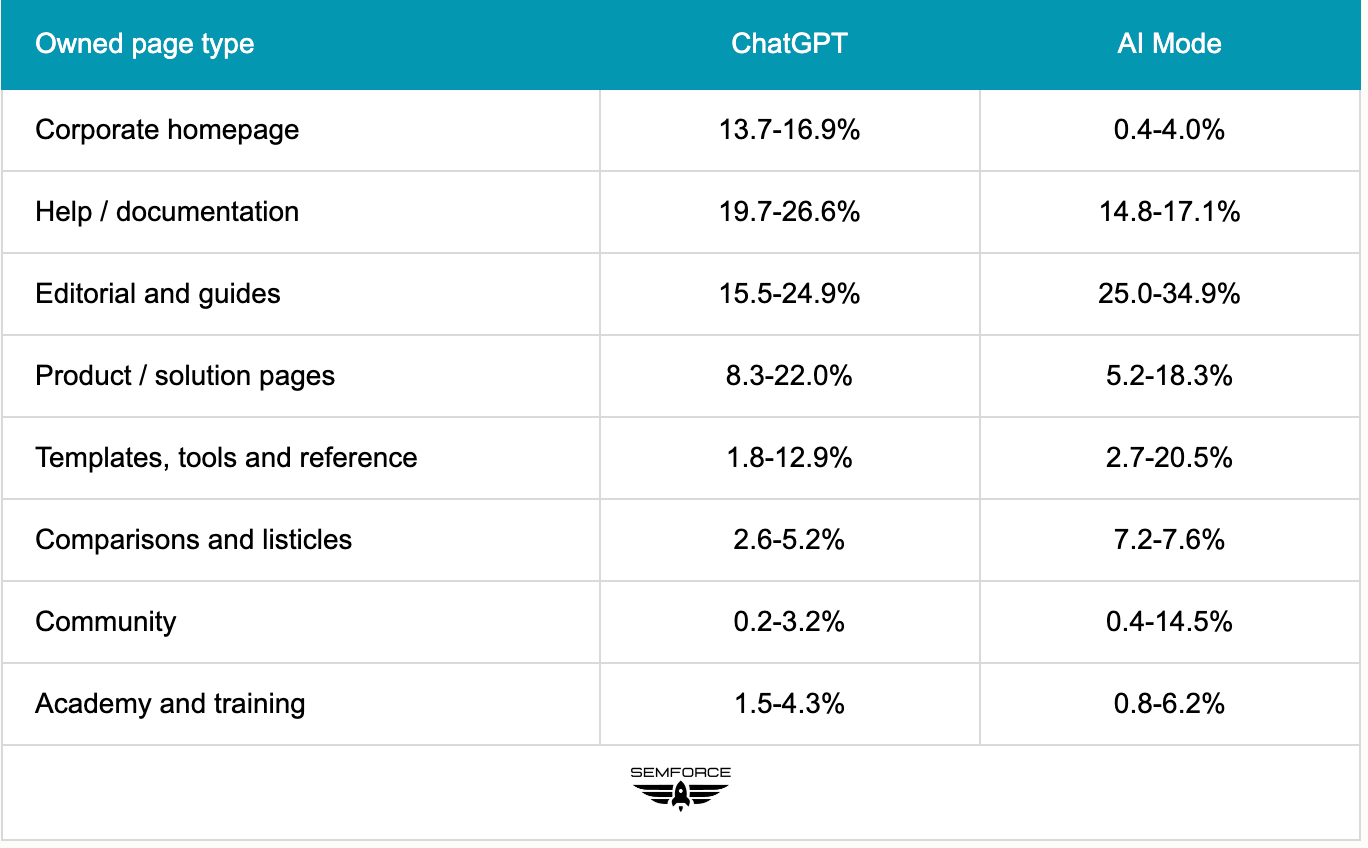
You need both layers in place: strong core pages that ChatGPT keeps citing, and specific, task-focused pages that AI Mode pulls from. Link them together so anyone who lands on one of these pages can easily find their way to a demo, a signup, or whatever the next step should be.
This is a structural choice and bigger than a content calendar. Publishing a blog post every week won't build this. Planning content around your positioning, your buyer's journey, and this citation data will. Take time to build a content strategy.
Treat your homepage and product hubs as ChatGPT citation assets
Corporate homepages carry 13.7 to 16.9 percent of ChatGPT's citation weight but only 0.4 percent in AI Mode. The pages most teams treat as static brand real estate are actually being pulled in as evidence. Keep your positioning, capabilities, pricing signals, and product names current and clear, since stale homepage copy turns into stale answer copy.
Invest heavily in help and documentation content.
Support content is the most consistently cited owned page type on both platforms, at 19.7 to 26.6 percent in ChatGPT and 14.8 to 17.1 percent in AI Mode. It's the only page type that never drops into single digits. That means it deserves the same editorial care, ownership, and update schedule as marketing content, since it's doing marketing's job inside AI answers.
Turn guides into your AI Mode citation engine.
Guides are AI Mode's biggest owned evidence type, at 25.0 to 34.9 percent, far higher than ChatGPT's share. Structure them around specific tasks and decisions at the depth AI Mode favors, not thin top-of-funnel posts.
4. The pages earning citations often don’t get AI traffic
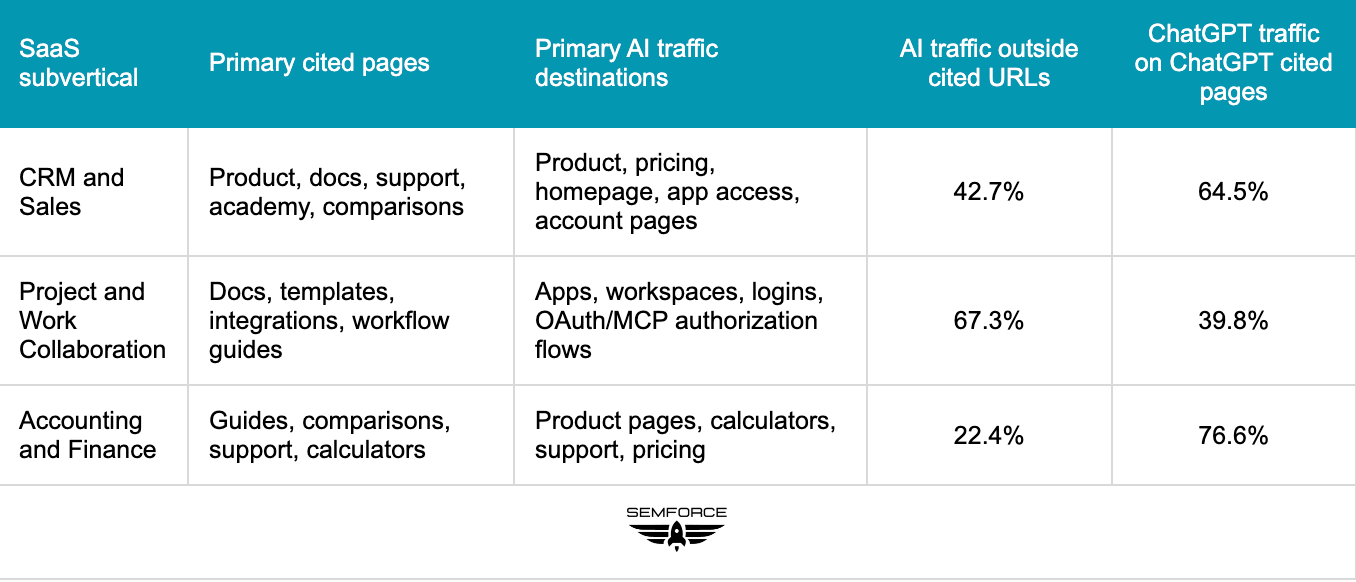
Citations and referrals track different stages: evidence versus action. That gap grows as products get more operational, making citation counts a poor stand-in for traffic.
5. There is no universal SaaS AI search playbook: optimize for your category's primary job
AI systems cite content based on what job the buyer in that category is actually trying to do. For CRM tools, buyers are trying to understand the product and decide to adopt it. For collaboration tools, buyers are trying to actually complete tasks and workflows. For finance tools, buyers are trying to avoid risk and make a safe decision.
So the content that gets cited looks different in each category, because the job looks different in each category.
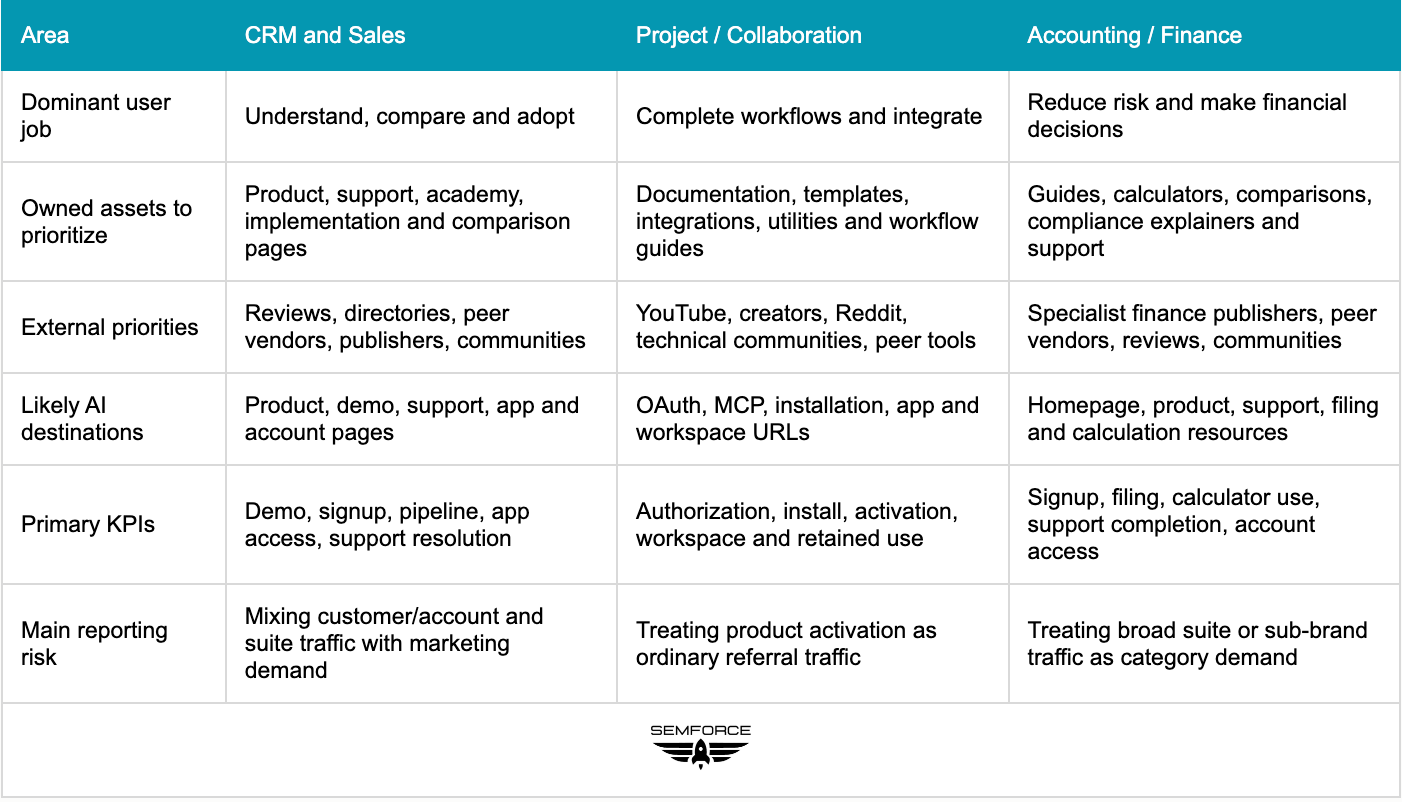
Name your category's main job before writing a single new page. Audit whether your cited pages, external sources and destinations actually serve it.
The bottom line
What happens after that click depends on your category. What gets cited depends on the platform. So build owned pages that establish authority, strengthen the outside sources that back you up. Make every destination useful, whether that's a pricing page, a calculator, or a signup flow.
No single tactic gets you there. PR earns the third-party coverage behind 84 to 93 percent of citation weight. Content strategy turns your own pages into citations AI reuses, then turns those citations into a path buyers actually follow.
GEO makes sure the technical side works once PR and content have done their job. Track all three separately. The brands that know which layer is working will keep compounding, while everyone else reports one number that explains nothing.
Browse Our Related Articles & Blogs
Dive into a wide range of blog posts featuring the latest projects, creative design ideas and innovative sustainable practices. Stay informed with expert industry updates that shape the future of construction.
%20(1)%20(1).png)

%20(1).png)
[F.A.Q.]
Frequently Asked Questions
Can’t find the answer you’re looking for? Please contact us.
Can’t find the answer you’re looking for? Please contact us
Your Tech Brand, Built for Growth
Flexible partnering for projects, retainers & everything in between