%20(2200%20x%20300%20px).png)
B2B Tech SEM Mastery: Drive Quality Leads with Strategic Search Marketing
.svg)
%20(1).png)
Mastering a sophisticated SEM strategy is essential for survival and growth, especially for B2B technology and SaaS companies.
Unlike B2C marketing, where transactions are often quick and emotionally driven, B2B tech Search Engine Marketing navigates complex challenges:
- Complex buying committees
- Long sales cycles
- The need to capture highly specific, high-intent user queries
This requires a nuanced approach that aligns Paid Search efforts with deep product knowledge and strategic business goals.
This comprehensive guide will move beyond the basics to provide an advanced framework for building and executing a winning SEM strategy.
We will explore how to:
- Align SEM with product marketing
- Master intent-based keyword research
- Structure campaigns for SaaS products
- Leverage AI-driven tools to optimize for lead quality and maximize return on investment
Prepare to transform your approach to search and drive meaningful, sustainable growth for your technology company.
Search Engine Marketing for B2B Tech Overview
Welcome to the strategic world of search engine marketing (SEM) for B2B technology companies.
This is a specialized discipline within Digital Marketing where sophisticated buyers research complex solutions through highly targeted search queries on platforms like Google Ads and Microsoft Advertising.
For tech businesses, SEM isn't just about driving clicks. It's about connecting with decision-makers, technical evaluators, and budget holders at the precise moment they are actively seeking a solution on search engines.
This guide delves into advanced ad formats that are crucial for reaching these key personas at the right stage of their buying journey:
- Responsive search ads
- Performance Max campaigns
- Lead form extensions
- Dynamic sitelinks
Definition of Search Engine Marketing for Technology Companies
In the B2B tech space, Search Engine Marketing is the practice of strategically investing in visibility for high-intent search queries that signal genuine solution evaluation.
It involves bidding on keywords that technical buyers, IT decision-makers, and business stakeholders use when actively researching:
- Software solutions
- Comparing vendors
- Seeking specific product capabilities
Unlike consumer marketing, B2B tech SEM focuses on capturing demand from multiple stakeholders within target accounts.
This often requires:
- A more patient approach
- Longer nurture sequences
- A focus on high-value conversions like demo requests or whitepaper downloads rather than immediate sales
The goal is to appear prominently on the search engine results page (SERP) when these critical searches occur.
Advanced Ad Formats in SEM for B2B SaaS
Modern B2B SEM has moved far beyond simple text ads, offering sophisticated formats designed to engage technical audiences and streamline lead generation.
Responsive Search Ads
These AI-driven ads allow you to provide multiple headlines and descriptions. Google's machine learning then tests various combinations to find the optimal ad copy for different B2B audience segments and product positions, ensuring your message always resonates.
Performance Max Campaigns
An AI-powered campaign type that optimizes across Google's entire ad inventory. It is particularly effective for SaaS companies with clear conversion goals, as it leverages Audience Signals to find high-value prospects across the Search, Display, YouTube, and Discover networks.
Lead Form Extensions
A powerful tool for B2B, these ad extensions allow you to capture prospect information directly within the Search Engine Results Pages (SERPs), reducing friction and making it easier to qualify leads before initiating sales conversations.
Dynamic Sitelinks
Automatically showcase specific product features, case studies, or solution pages that are most relevant to a user's particular search query, creating a more tailored and informative ad experience.
The Strategic Approach: Aligning SEM with Product Marketing
An effective B2B tech SEM strategy cannot exist in a vacuum. It must be a direct reflection of your unique product-market fit, competitive positioning, and go-to-market approach.
To develop a powerful advertising strategy tailored to your business goals:
- Map Keywords to the Buyer Journey - Align keywords to specific stages, from problem awareness ("how to automate workflows") to vendor comparison ("[Your Product] vs [Competitor]").
- Align Ad Messaging with Product Positioning - Ensure your ad copy and landing page content highlight the unique value propositions defined by your product marketing team.
- Structure Campaigns Around Ideal Customer Profiles (ICPs) - Move beyond generic demographics and build campaigns that target specific industry verticals, company sizes, or user personas.
- Integrate SEM Data with Product Analytics - Use tools like Google Analytics to understand which search behaviors and messaging lead to the highest rates of product adoption and user engagement.
Your SEM success depends on creating compelling ads that not only resonate with technical decision-makers but also support and amplify your broader product marketing narrative.
SEM vs. SEO for Technology Companies
Let's explore how search engine marketing (SEM) and Search Engine Optimization (SEO) function as two powerful, yet distinct, pillars within a comprehensive B2B tech marketing strategy.
Both aim to increase your visibility on the search engine results page, but they achieve this through different means and deliver on different timelines.
Paid vs. Organic: Complementary Growth Engines
SEM and SEO should not be viewed as competitors for budget, but as complementary growth engines.
SEM, the paid component, delivers:
- Immediate visibility for competitive keywords through platforms like Google Ads
- Powerful tool for launching new products
- Quick entry into new markets
- Immediate demand capture
SEO, on the other hand, is the practice of earning organic visibility through:
- Valuable content creation
- Technical site optimization
- Authority building
- Long-term investment that builds trust and sustainable traffic
For B2B tech companies, you are investing in immediate market visibility with SEM while simultaneously earning long-term trust and authority through SEO. This is a crucial distinction when planning an integrated digital marketing strategy.
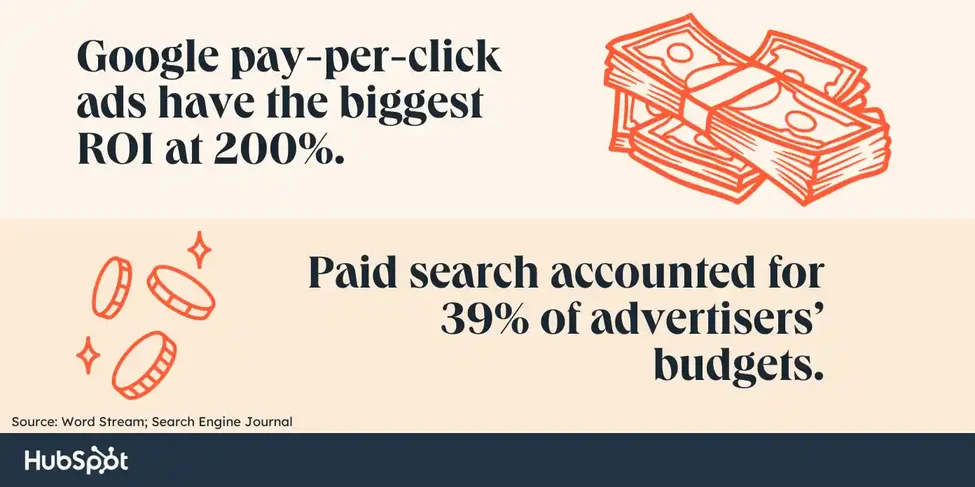
According to industry analysis, paid search ads are highly effective making it a top channel for acquisition.
The most successful B2B tech companies use both tactics synergistically. For example, insights from a PPC Campaign can inform your SEO content strategy by revealing which keywords and messaging drive the highest-quality conversions.
Source: Search Engine Journal
Tip - Moz has an excellent beginner's guide if you need deeper insights into SEO for technology companies.
Best Practices for B2B Tech Companies
Create Technical Content Clusters
Use SEO to build deep, authoritative content around core technical problems your product solves.
Use SEM for High-Intent Keywords
Target bottom-of-funnel keywords with paid ads to capture users actively looking to buy.
Test Messaging with SEM
Use the speed of SEM to A/B test value propositions before committing to them in long-term SEO content.
Occupy More SERP Real Estate
Having both a paid ad and a top organic listing for a key term significantly increases credibility and Click-Through Rates (CTR).
Keywords - The Foundation of B2B SEM Strategy
Unlock the secret to high-performing B2B tech SEM campaigns: an intent-driven keyword strategy.
Keywords are more than just words. They are the language of your potential customers. They form the backbone of any successful B2B technology search marketing program by connecting your solutions to the problems your audience is trying to solve.
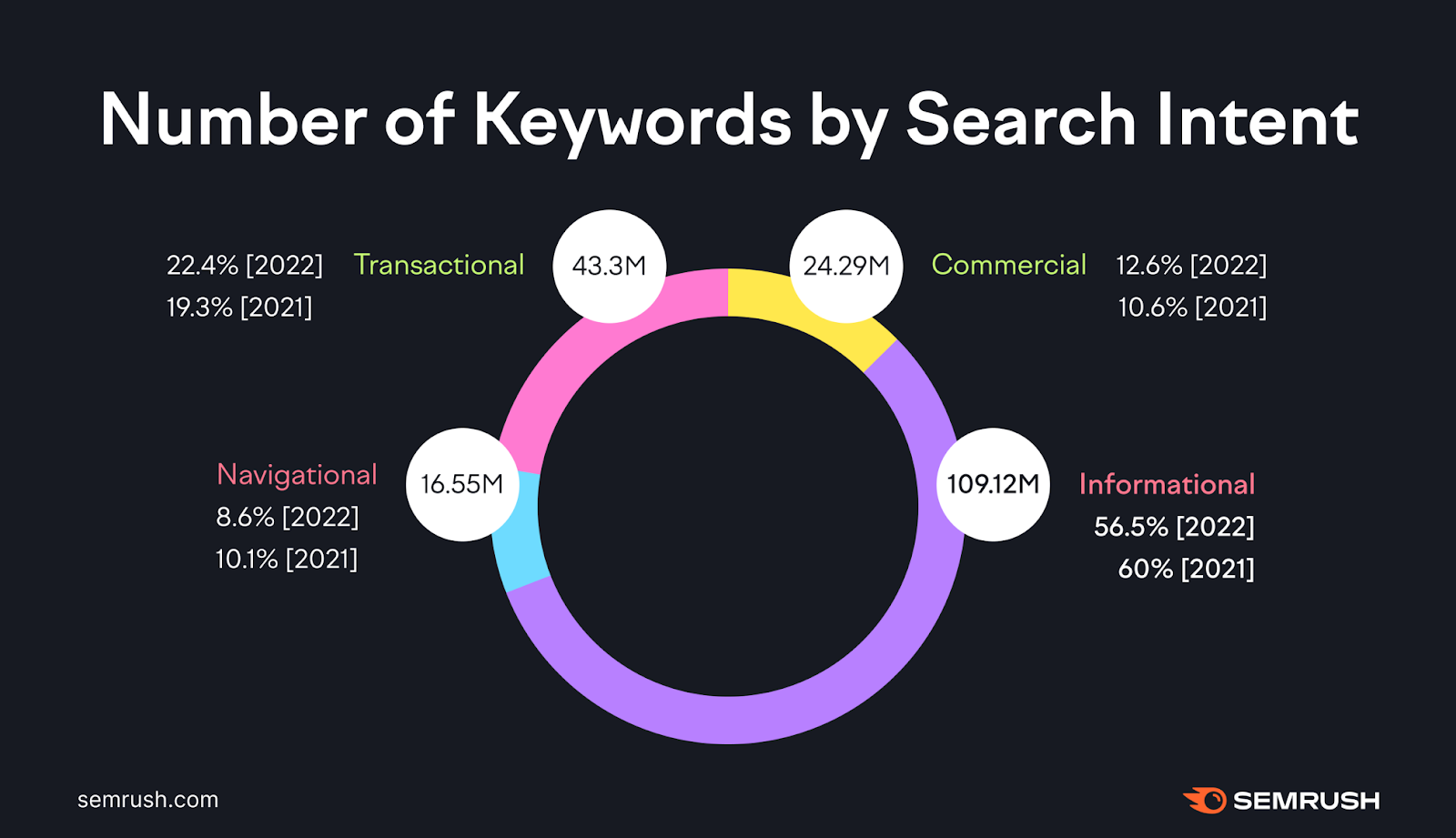
The Importance of Intent-Based Keyword Research
Source: Semrush
Effective Keyword Research for B2B tech companies goes far beyond using generic keyword tools to find high-volume terms.
It requires a deep understanding of the sophisticated language your buyers use when evaluating solutions.
This means analyzing not just what they search for, but the intent behind those searches:
- Are they identifying a problem?
- Are they comparing solutions?
- Are they ready to purchase?
Answering this question is critical for aligning your ads and landing pages with their position in the sales funnel.
Finding High-Value B2B Keywords
In B2B SEM, precision is far more valuable than volume.
The goal is to identify keywords that signal genuine buying intent from qualified prospects. These are often specific, technical terms like:
- "enterprise API management solution"
- "HIPAA compliant cloud storage"
- "workflow automation software comparison"
Use a combination of tools like the Google Keyword Planner within your Google Ads account, alongside third-party platforms like Semrush and Ahrefs, to uncover these high-value terms.
When using a Keyword Planner, focus on:
- Commercial intent keywords
- Analyze search volume within your specific target market
- Understand the competitive dynamics of your product category
Creating Your Strategic Keyword Portfolio
To build a robust keyword strategy, organize your terms with a clear intent architecture in mind. This ensures you are meeting prospects with the right message at the right time.
Solution-Aware Keywords Prospects know they need a solution like yours but haven't chosen a vendor.
- Example: "marketing automation platform," "CRM for SaaS companies."
Product-Aware Keywords Prospects are actively comparing specific solutions, including yours.
- Example: "[Your Product] vs [Competitor]," "[Your Product] pricing."
Brand-Aware Keywords Prospects are specifically researching your company and its offerings.
- Example: "[Your Company] reviews," "[Your Company] demo."
Long-Tail Keywords: The B2B Advantage
Precision beats volume in B2B tech.
Long-tail keywords may have lower search volumes, but they are incredibly effective for B2B companies. Their specificity aligns perfectly with how technical buyers actually search for solutions.
A detailed search query like "GDPR compliant email marketing automation for SaaS" indicates:
- A highly qualified prospect with a specific need
- Much higher conversion rates than generic, high-volume keywords
Evolving Your Keyword Strategy
B2B technology markets shift rapidly.
New product features, emerging competitors, and evolving regulations all impact how your prospects search. Your keyword strategy cannot be static.
Regularly review performance data, use tools like Google Trends to spot emerging search patterns. Refresh your keyword portfolio to ensure your campaigns capture new opportunities and maintain a competitive edge. Also, stay informed with industry resources like Search Engine Journal.
In B2B tech SEM, your keyword strategy is not just about driving traffic. It's about connecting with the right prospects, at the right moment, using the precise language that reflects their technical needs.
Account Structure & Keyword Grouping for SaaS Products
Optimizing B2B tech SEM campaigns begins with a strategic account architecture that mirrors your product offerings and customer segments.
A high-performing Google Ads or Microsoft Advertising account for a technology company should be organized around clear business logic, not just random keyword themes.
This foundational structure is critical for:
- Efficient management
- Accurate reporting
- Effective scaling
Campaign Organization Based on Product Lines and Customer Segments
The most effective way to structure your SEM account is to build campaigns around your core product offerings and distinct buyer segments.
This approach makes budget allocation and performance tracking significantly more strategic and insightful.
Recommended B2B Tech Campaign Structure:
- Core Product Campaigns - Create separate campaigns for each major product line or solution category (e.g., "Data Analytics Platform," "Cybersecurity Suite").
- Competitor Campaigns - Build dedicated campaigns that target competitor brand names and comparison keywords (e.g., "Salesforce alternative").
- Brand Defense Campaigns - Run a campaign to protect your own brand terms, ensuring you capture all brand-aware traffic and control the messaging.
- Customer Segment Campaigns - If you serve distinct markets, create different campaigns for enterprise vs. mid-market vs. SMB segments, allowing for tailored messaging and bidding.
This structure enables you to:
- Allocate budget based on product priorities
- Track ROI by solution area
- Optimize messaging for specific audience segments
Creating Intent-Based Ad Groups for B2B Buyers
The secret to high-performing B2B SEM is creating hyper-focused ad groups organized by buyer intent and journey stage.
Each ad group should contain a tightly related set of keywords that represent the same core search query intent.
This precision targeting is what enables you to write highly relevant ad copy and direct users to the perfect landing page, which are key components of a high Quality Score.
Strategic Ad Group Framework:
Problem-Aware Groups -
- Keywords: "workflow bottlenecks," "manual process inefficiencies"
- Ad Focus: Educate on the problem and introduce your solution category.
Solution-Aware Groups -
- Keywords: "workflow automation software," "business process management tools"
- Ad Focus: Highlight product capabilities and key differentiators.
Vendor Comparison Groups -
- Keywords: "[Your Product] vs [Competitor]," "best workflow automation platforms"
- Ad Focus: Emphasize competitive advantages and unique value propositions.
Tips for Superior B2B Tech Ad Groups
Map to Sales Conversations
Organize ad groups around the actual language and pain points your sales team hears from prospects during discovery calls.
Leverage Product Marketing Insights
Use messaging frameworks from your product marketing team to ensure ad group themes align perfectly with your company's positioning strategy.
Maintain Tight Keyword Clusters
Keep ad groups small and focused, ideally with 15-25 highly related keywords maximum. This improves ad relevance and boosts your Quality Score.
Test Messaging Variations
Within each ad group, continuously test different value propositions in your ad copy to identify which messages resonate most powerfully with specific buyer intents.
Remember: Your account structure should make it easy to optimize spend based on business priorities, measure ROI by product line, and deliver personalized experiences throughout the buyer journey.
The Ad Auction Process in 2026
Ready to master the sophisticated world of B2B ad auctions?
The global search advertising market is a massive force, projected to be worth US$351.55 billion in 2025. To compete effectively, B2B tech companies must understand how Google's AI-enhanced auction system works and what it means for your SEM strategy.
Understanding AI-Enhanced Bidding and Quality Score Evolution
The modern ad auction is powered by a dynamic duo: your maximum bid and your Quality Score, both of which now operate within Google's advanced AI optimization systems.
This creates auction mechanics that are far more sophisticated than ever before.
Smart Bidding Integration
Successful B2B campaigns increasingly rely on automated bidding strategies like Target CPA (Cost-Per-Acquisition) and Target ROAS (Return on Ad Spend).
These strategies use machine learning to optimize for business outcomes like:
- Lead quality
- Pipeline value
- Not just clicks or impressions
Enhanced Quality Score Factors
Google's 2026 Quality Score algorithm places a heavy emphasis on user experience signals. The three core components remain, but their evaluation is more nuanced:
- Landing Page Experience The relevance of your landing page to the user's intent is paramount.
- Ad Relevance The connection between the keyword, your ad copy, and the landing page must be seamless.
- Expected CTR Google predicts the likelihood of a click based on historical performance patterns for similar B2B queries.
Ad Rank Calculation & Performance Max Integration
The intelligence behind your ad's placement on the search engine results page is called Ad Rank.
This calculation now incorporates a vast array of machine learning signals that predict conversion likelihood based on:
- User behavior
- Device
- Time of day
- Dozens of other contextual factors
While the fundamental formula remains (Maximum Bid × Quality Score = Ad Rank), Google's systems apply AI optimization layers that can significantly boost the ad position for campaigns that demonstrate strong business outcomes.
This is where Performance Max campaigns integrate, using their broad reach and automated optimization to feed the system valuable conversion data, which in turn helps inform and improve performance across your entire account.
Advanced Strategies for B2B Tech Companies
Implement Smart Bidding Early
For B2B tech companies, campaigns using Target CPA or Target ROAS consistently outperform manual bidding after an initial learning period.
Optimize for Business Metrics
Go beyond simple form fills. Set up conversion tracking for demo requests, trial sign-ups, and Marketing Qualified Leads (MQLs) to give Google's AI the right data to optimize for quality.
Leverage Audience Signals
Use your first-party data (like CRM lists) and lookalike audiences to provide Google's algorithm with powerful signals about your ideal customer profile.
Integrate Performance Max
For SaaS companies with clear conversion paths, Performance Max campaigns can significantly expand reach and find new pockets of high-intent users while maintaining cost efficiency.
Action Step: Audit your current bidding strategies and Quality Score components. B2B tech companies that embrace AI-enhanced bidding while obsessing over user experience will win in the modern ad auction.
Advanced SEM Performance Optimization
Ready to transform your B2B tech SEM performance from good to exceptional?
Let's dive into advanced optimization strategies that are specifically designed to align with sophisticated buying processes, long sales cycles, and the unique challenges of the technology sector.
This goes beyond basic bid management to focus on true business impact.
Strategies for B2B Lead Quality and Product-Market Fit Alignment
Quality Score optimization for B2B tech requires a fundamentally different approach than for B2C campaigns.
Success hinges on creating ad experiences that demonstrate a deep understanding of your technical buyers' specific needs and challenges.
Critical Optimization Areas:
Ad Copy Relevance for Technical Buyers
- Use industry-specific terminology that resonates with your Ideal Customer Profile (ICP)
- Address specific use cases, integrations, and technical requirements directly in your ad text
- Include qualification language (e.g., "For Enterprise Teams") to attract serious evaluators and deter unqualified clicks
Landing Page Experience Optimization
- Ensure your landing pages perfectly match the specific intent and product focus of each ad group
- A user searching for "API security" should not land on a generic homepage
- Provide clear conversion paths for different buyer journey stages (e.g., Learn More, Request Demo, Start Trial)
- Include technical specifications, integration capabilities, and security/compliance information that B2B buyers require to make informed decisions
The Compound Effect of B2B SEM Optimization
Your optimization efforts create exponential returns over time.
A higher Quality Score leads to better ad positions at a lower cost-per-click. This improves your Click-Through Rates, which further enhances your Quality Score, creating a virtuous cycle of continuously improving performance and efficiency.
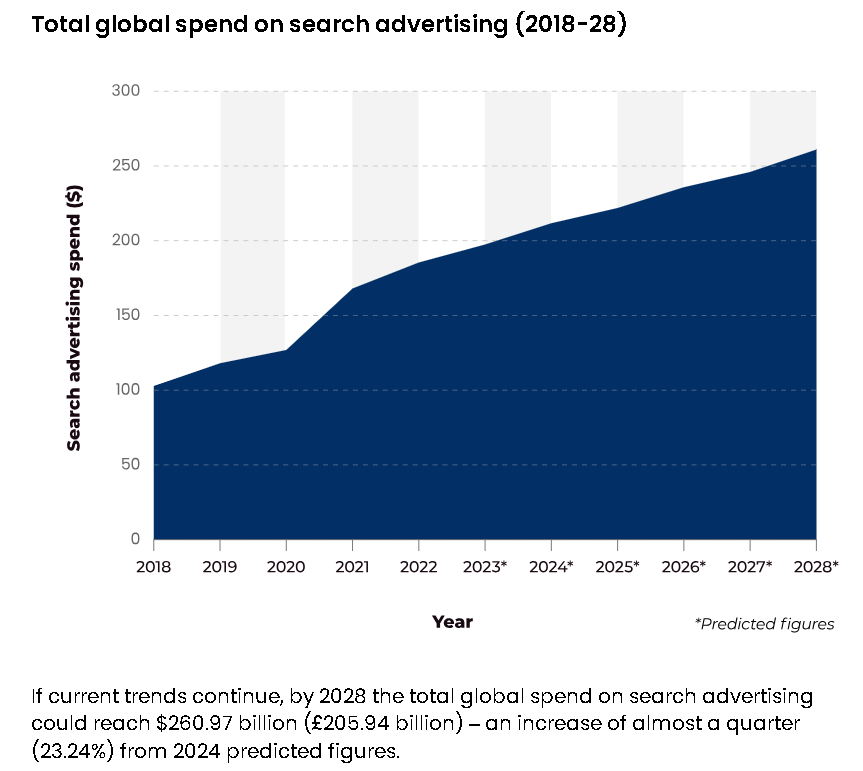
This ongoing growth is why investment in search advertising continues to rise, with projections showing companies will spend $260.97 billion by 2028.
Source: Reboot Online
Key Performance Drivers for B2B Tech:
- Product-Market Messaging Alignment Your ad copy must reflect your unique positioning and speak the language of your buyers.
- Conversion Path Optimization Design landing pages that are built for the complexities of B2B buying processes.
- Lead Scoring Integration Track not just conversions, but qualified leads that move through your sales pipeline, and feed this data back into your bidding strategy.
- Account-Based Targeting Use audience layering to focus your ad spend on specific target account lists, maximizing efficiency.
Implementation Roadmap
- Audit current campaign performance using tools like Google Analytics and your CRM to identify gaps in lead quality
- Revise ad copy and landing pages based on insights from actual sales conversations and product marketing documentation
- Implement advanced conversion tracking that measures true business impact (pipeline generated, deals closed), not just marketing metrics
- Test audience layering strategies to focus spend on accounts that match your ideal customer profile
- Monitor and optimize regularly, with a relentless focus on pipeline impact and customer acquisition cost (CAC)
Pro Tip - B2B tech companies that optimize for business outcomes (pipeline generated, customers acquired) rather than vanity metrics (clicks, impressions) typically achieve significantly better ROI from their SEM investments.
What Makes B2B SEM Different from B2C?
B2B tech SEM focuses on longer sales cycles, multiple decision-makers, and higher-value transactions.
Successful B2B campaigns prioritize:
- Lead quality over volume
- Technical language that resonates with professional buyers
- Integration with CRM systems to track pipeline impact rather than just immediate conversions
The focus is on starting a valuable business relationship, not making a single sale.
How SaaS Companies Scale SEM Effectively?
SaaS companies scale SEM by focusing on customer lifetime value (CLV) optimization rather than just initial acquisition costs.
This includes:
- Implementing cohort-based bidding strategies that value leads from different segments differently
- Leveraging product usage data for audience refinement and remarketing
- Creating expansion campaigns that target existing customers with new product offerings or plan upgrades
Best SEM Strategies for 2026
The most effective 2025 B2B SEM strategies will heavily emphasize:
- AI-enhanced bidding (like Target ROAS) supported by strong offline conversion tracking
- Performance Max campaigns for qualified lead generation across all of Google's channels
- Deep integration of first-party data (from your CRM and product) for superior audience targeting
- Cross-platform attribution models that connect initial search behavior to eventual product adoption
- Integration with Account-Based Marketing (ABM) platforms to target high-value enterprise prospects
B2B Tech SEM Budget Structure
Allocate SEM budgets based on customer segment value and strategic product priorities.
A typical, mature structure might look like this:
- 40% for core product/solution campaigns
- 25% for competitor targeting
- 20% for expansion/upsell campaigns to existing customers
- 10% for brand defense
- 5% for experimenting with new keywords, channels, or ad formats
ROI Timeline for B2B Tech SEM
B2B tech SEM typically shows:
- Initial traction (impressions, clicks) within 30-60 days
- Meaningful lead generation (demo requests, trial signups) within 90 days
- Full ROI assessment requires 6-12 months due to longer sales cycles
Companies should measure both leading indicators (MQLs) and lagging indicators (closed deals, customer LTV) to get a complete picture of performance.
Final Thoughts
Search engine marketing for B2B technology companies demands a sophisticated strategy that goes far beyond generic digital advertising approaches.
Success depends on a deep understanding of:
- Technical buyer behavior
- The ability to navigate complex sales processes
- A relentless focus on demonstrating clear business impact
The worldwide search marketing landscape is vast and competitive, and a generic approach is a recipe for wasted ad spend.
The Strategic Advantages of B2B-Focused SEM
Implementing the advanced strategies outlined in this guide can dramatically improve your customer acquisition efficiency and sales pipeline quality.
From intent-based Keyword Research to AI-enhanced bidding optimization, these tactics can transform your SEM program into a powerful and predictable engine for growth.
Integration is Everything
Remember that SEM works best not in isolation, but as a core component of an integrated go-to-market strategy that includes:
- Search Engine Optimization
- Content marketing
- Product marketing
- Sales enablement
The most successful B2B tech companies use search marketing insights to inform their entire marketing ecosystem, creating a powerful feedback loop that drives continuous improvement and cements their position as leaders in the market.
Browse Our Related Articles & Blogs
Dive into a wide range of blog posts featuring the latest projects, creative design ideas and innovative sustainable practices. Stay informed with expert industry updates that shape the future of construction.
%20(1)%20(1).png)
%20(1)%20(1)%20(1).png)

[F.A.Q.]
Frequently Asked Questions
Can’t find the answer you’re looking for? Please contact us.
Can’t find the answer you’re looking for? Please contact us
Your Tech Brand, Built for Growth
Flexible partnering for projects, retainers & everything in between